
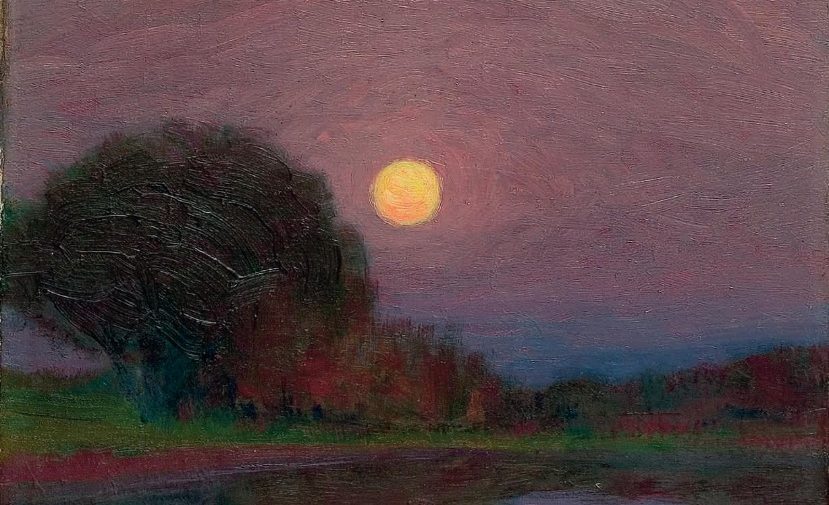
IHS hosts an intimate exhibit of Dow art and memorabilia Arthur Wesley Dow honored—officially
No other establishment in the country boasts a collection of Arthur Wesley Dow’s art like the Ipswich Historical Society and Museum. The IHS is currently hosting an exhibit, titled “Arthur Wesley Dow of Ipswich,” to include his paintings, woodcuts, photographs, furniture, letters, and memorabilia. And rightly so—Dow was a founding member of the Ipswich Historical Society, born and raised in the North Shore town, founded an art school there, artistically immortalized, and kept the town sacred in his heart throughout his life.
Through the exhaustive efforts of IHS Executive Director Bonnie Hurd Smith, Dow’s art is finally and indisputably honored and sanctioned by the bright lights of the professional art world. Trevor Fairbrother, renowned art historian, author, and curator of the Peabody Essex Museum’s summer exhibit, “Painting Summer in New England,” heartily agrees and has given three of Dow’s works singular distinction at the Salem museum.
“I wanted to give Dow pride of place in the exhibit,” Fairbrother said of his tour de force exhibition at the PEM. “Dow was that rare artist who could savor what was fine about historic New England culture and still advocate for modernity in the arts,” he said.
IHS’s Executive Director Smith has said that "Trevor's deep interest in Dow, and his unique understanding of his place in the history of American art will...finally give Dow the exposure and appreciation he deserves. We couldn't be more grateful to Trevor and the PEM for enabling this to happen, which, in turn, will benefit the [Ipswich] Historical Society immeasurably."
According to the IHS Curator of Dow’s works, Stephanie Gaskins, “At the turn of the 21st century, with everyone looking back to 1900, Dow was given new attention, and his influence continues to grow. His art is sought after by museums and is regularly featured in major Arts and Crafts exhibits. Today, the public, art aficionados, and academics want to know more about his teaching philosophy and his art. When visitors come here after they’ve seen “Painting Summer in New England” [at the PEM], we want them to learn about Dow the man, in his hometown,” said IHS Dow Curator, Gaskins.
What’s special about Arthur Wesley Dow?
Dow single-handedly changed the teaching of art in the late 1800s with his innovative text, “Composition: A Series of Exercises in Art Structure for the Use of Students and Teachers,” which has been reprinted numerous times. Many of the country’s most famous painters (Georgia O’Keeffe, Max Weber), photographers (Edward Steichen), ceramicists, printmakers, and even furniture makers were Dow students and subscribed to his innovative methods of viewing and creating art. Moreover, Dow was a proponent of notan, the classic Japanese model for lights and darks, combined with an agreeable arrangement of line and color which Dow dubbed “the trinity of power.” In revolutionizing the teaching of art, Dow felt that the elements of composition and design required a “new appreciation of all forms of art and the beauty of nature.”
“In [his book] ‘Composition’, Dow put forth a new philosophy of art with beauty at its core,”
said IHS Director Smith. “The understanding of three elements—line, color, and “notan” (the variation of light to dark)—was the method by which art could be appreciated and produced. Dow strove to synthesize the western and eastern aesthetic.”
One feature art historians and amateurs alike seem to articulate about Dow is that his art is pretty, in fact, beautiful. Dow believed that nature is indeed beautiful, and that’s a factor (but not the major elements) of his appeal as an artist. He wasn’t afraid to use beauty within the context, study, and mechanics in the making of great art.
In an address to the Ipswich Historical Society in 1915, Dow immortalized his beloved town:
“May I say a word or two about Ipswich from the artist’s point of view, speaking not only for the artists who live here or who visit us...but for all who appreciate the natural scenery of our town, and who treasure the things of beauty that have come to us from former generations—the houses which our fathers built, the furniture that they made with their own hands, and the Elm trees that they planted along our streets.”
Many of Dow’s “favorite subjects are [still in existence and] within walking distance of his birthplace,” and final resting place, IHS’s Smith has said. Arthur Wesley Dow’s art is meant to be admired, not merely for its conspicuous beauty, but for the legacy of yesteryear’s Ipswich he has left behind, for the town, for New England, and for the nation.
The Dow exhibit is now on display at the Ipswich Historical Society and Museum (Heard House), 54 South Main St., Rte. 1A, Ipswich. For information on this exhibit, visit the IHS website at www.ipswichmuseum.org or call 978-356-2811 for exhibit hours and directions.
Dorothy V. Malcolm is a history and arts writer in the metro-Boston area.