
Grand Keepsakes from the Gilded Age
By Dorothy V. Malcolm
When driving around the thirty-four towns of Essex County, past the usual mid-century modern land-and-cityscapes, we tend to slow down and marvel at the occasional acre of still-virgin land whose horizon is broken only by a stately and elegant home. Time stops; breath momentarily taken away; and our current era blurs as we gaze vicariously on the past with admiration, a touch of envy, and longing.
Recently, Turner Hill in Ipswich hosted author Pamela W. Fox for an evening gathering celebrating some of the North Shore’s most beautiful architecture and natural landscapes. In her book, “North Shore Boston Houses of Essex County 1865-1930," Fox delivered an enlightening presentation honoring the pioneers and preservationists who have safeguarded, restored, and even recycled some of the distinguished homes of post-Civil War Essex County. Ms. Fox also highlighted, in her PowerPoint presentation, the diverse architecture and natural lands of the late 19th and early 20th centuries that have been pillaged or demolished. Factors ranging from the Industrial Revolution to the Great Depression have decimated sites like "Avalon,” "Kragside," and Henry Frick’s estate, “Eagle Rock” in Prides Crossing, to name just a few.
Such glimpses of regional beauty are sweet to the eye and rich to the New England soul. That some portions of North Shore haven’t succumbed to urbanized blight, like other regions, Essex County can boast some of the most beautiful vistas from days past, blessedly rescued from industrialization and mediocrity. Despite the demolition of some North Shore treasures, Fox was quick to salute the works of the E.C. Greenbelt. The Trustees of Reservations, Ipswich’s Great Estates Preservation By-Law, included the E.C. Trail Association. Mainly, the efforts of enlightened, proactive citizens who understand the “delicate impermanence” of the land with vigilance and constant stewardship remains exemplary.
What we have lost
Sadly, some pictures of magnificent residences flashed on the screen, only for the audience to be crestfallen to learn from Fox that they had been torn down. A-ASID Interior Designer Karen Goodel of Atelier Panache in Essex was in the audience and said, “It’s wrenching, even heartbreaking, to see pictures of these wonderful homes, then to find out they were demolished. As an interior designer (and, in fact, everyone) can appreciate the work that went into these buildings and the decorative arts that characterized them. And now they are all gone. These gems are irreplaceable.”
However, not all was lost, and many still stand today as testaments to posterity, elegance, and craftsmanship. According to Fox, when Bostonians wanted to escape the stifling summer heat of the city, they discovered the beauty and breezy allure of the North Shore and built their summer “cottages” along towns that kiss the water or farther inland to accommodate equestrian pursuits. The names of some of the North Shore’s summering crowd are contained in the arenas of literature, medicine, industry, law, politics, art; names like Longfellow, Agassiz, Lodge, Mudge, Little, Dexter, Paine, Lowell, Loring, Dana, Hale, Rice, Mosley—a mere drop in the North Shore bucket of wealth and privilege. These names resonate because of what they left behind, flattering and bequeathing a very fortunate Essex County with some remnants of the Gilded Age.
It is simple to recognize the difference between the Bostonian summer estates and preference for architecture from those of out-of-towners. Boston Brahmins built summer homes in a typically olde yankee fashion: shingle-style homes on the water, like many found in Manchester, or in the perfect symmetry of colonial revival and federal styles in Beverly Farms and Hamilton-Wenham, for example. Eventually, between 1890 and World War I, non-Bostonians prevailed upon the reserved habits and lifestyles of the Bostonians by “erecting more elaborate, grander types of homes; more ostentatious than their more conservative neighbors,” Fox said. “Their ‘cottages’ were more splendid and grandiose, many in the French and Italian styles.” Some newcomers even went so far as to embrace the utterly disparaged and brand new Arts and Crafts look (aka Mission, Craftsman) style of architecture and decorative arts—perfectly embodied at Willowdale, Bradley Palmer’s estate in Topsfield along the Ipswich River.
Those moneyed industrialists and “idle rich” came from as far away as Canada, the Midwest, and even New Orleans to enjoy summering near the cool, craggy coast of northern Massachusetts. Most of the newcomers “wanted to meet other people of wealth and similar kinds of status in terms of business and affluent lifestyles,” Fox said. Many of their somewhat unusual summer homes can still be found in the likes of Beverly Farms’ Villa Al Mare, in the Italian style; or Manchester’s Villa Crest, now repurposed, thankfully, as part of The Landmark School; or the French-styled Tower of Four Winds in Gloucester—magnificent homes, all, but very un-Bostonian!
Turner Hill, Ipswich
The site of the venue, Turner Hill, can boast some of Ipswich’s finest architecture and decorative arts. Built by William G. Rantoul in 1900, it was the home, farm, and lands of importer and industrialist Charles N. Rice. Both owner and architect toured Europe to define and design the estate. What they seamlessly blended was a collection of styles ranging from Elizabethan, Jacobean, and Flemish design elements with gardens and ponds that became “one of the finest estates on the North Shore,” according to author Fox. But no one ever dreamed the Gilded Age would tarnish and vanish—it was supposed to last forever. When times change, cold, practical choices have to be made. Turner Hill, like most of the stately homes of Essex County, was left relatively orphaned and in need of assistance and care. Upon Rice’s death in 1943, the estate became the National Shrine of Our Lady of LaSalette. Fortunately, the Archdiocese of Boston, prior to its current troubles and finances, bought several North Shore estates and converted them into convents, monasteries, retreat houses, and schools. Thanks to developer and philanthropist Ted Raymond, the mansion was revitalized as a country inn with an 18-hole golf course and outstanding grounds.
The Garland Estate, Hamilton
One of the jewels in Hamilton’s crown, this Jacobean manor house, with its vaulted ceiling beams, double grand staircase, three-story hall, and paneled wainscoting, has seen several incarnations and monikers, yet happily is still with us. It was sold in 1905 and called Brackensade, then Foxhollow. Catering to those operating and living in “horse country,” even an expert horsewoman, HRH Princess Anne of England, visited the Garland Estate in 1970. This mansion offers an imaginary journey to Olde England during the height of English gentry living. When it was donated to the Town of Hamilton, they leased it to the U.S. Equestrian Team. Sold again in 1994, the estate grounds are still utilized for equestrian training.
The Loring House, Prides Crossing
Pamela Fox says it perfectly in her book: “Above Plum Cove on a prominent headland sits a stone-and-shingle house that appears to have grown organically out of the massive granite boulders that line the Beverly coast.” The General Charles Greely Loring House, sometimes known as “Pompey’s Garden,” was built in 1881 by architect William R. Emerson. Gen. Loring was one of the original North Shore summer settlers who saw the benefits of Boston’s North Shore. This house is the epitome of the “Boston style,” a uniquely American/New England shingle-style cottage overlooking the Atlantic. A free-form building, it has a “rusticated stone base, dark brown stained shingles, a round tower, sweeping piazzas, a complex roofline and a Palladian window,” according to Fox. The extraordinary gardens would be considered an unstudied exercise in their wild and natural arrangement. This model of post-Civil War “Americana” is still a private residence and a salute to an architectural style that exemplifies Boston’s “gold coast.”
Castle Hill, Ipswich - Both of Them
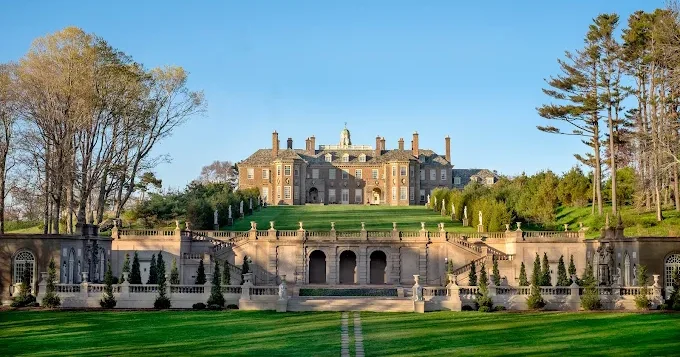
Of all the homes in the North Shore, surely the Crane Estate has been able to boast not one but two Castle Hill mansions. The first was completed in 1912 by architects Shepley, Rutan & Coolidge and held 60 rooms in the grand Italian Renaissance villa. Plumbing magnate Richard T. Crane Jr. decided to “make America want a better bathroom” and promptly installed top-of-the-line plumbing. In 1924, Castle Hill I was razed and replaced by the present mansion in the Georgian style. Eclectic architect David Adler built Castle Hill II in a 17th-century English style and set it amid terraces and formal gardens (much of it designed by F.L. Olmstead), most notably, its “backyard,” The Grande Allée. Aside from all its modern plumbing, today’s Castle Hill is utterly breathtaking, designed with the best in decorative arts. Designated as a National Historic Landmark, the estate is owned and nurtured by the Trustees of Reservations and available for public and private events. The generous Crane family donated nearly 2,000 acres, including Hog Island and Crane’s Beach, to the trustees.
Of the more than 20 mansions, estates, and lands that have been demolished, there are still enough that are, thankfully, still living—And they are living, breathing entities that have housed the rich and famous; whose walls, ceilings, floors, and windows whisper histories and sagas of people, secrets, tragedies, and celebrations of a time, now absent, but not silent or dead. As long as there are citizens and agencies willing to preserve the past and present for posterity—our descendants—then the protected, enchanting splendor, grace, and memory of bygone eras will indeed live.
Dorothy Malcolm is a metro-Boston freelance writer.