
Regan’s Palette Stonehill College
Library Exhibit
By Dorothy V. Malcolm
::Features Correspondent
Article first appeared in "The Milton Townsman," October 1995, Associated Media, Boston
The creative process: It exists because musicians hear sounds differently, writers conceptualize the world around them into words, and painters see the world more astutely than most of us.
The process is an ongoing one. The notion that you can start with a thought and finish with something tangible is the essence of creativity. This process is apparent in the works of Canton artist Joanne F. Regan, whose paintings are on exhibit at the library at Stonehill College in Easton until October 30.
Stepping into Joanne Regan’s studio is much like stepping back into childhood, with all the delights of sight, sound, smell, confections, and playthings, nudging those memories and leaving one on the verge of a giggle as one imagines a pirouette in front of her warm, pot-bellied stove. Hanging from beams are baskets overflowing with antique dolls, teddy bears, marionettes, nutcrackers, and stuffed calico cats. Alongside these, drying summer flowers hang in unison with scarred, old jugs and campfire coffeepots near the loft and skylight. In the corner, yellowing lace sheaths an elderly dress hanging from a rafter, yet dwells comfortably with paint-spattered smocks, easels, books, eucalyptus, and an exhausted straw hat. Classical music, something Baroque, plays softly from a cassette somewhere in another corner. Every inch of Regan’s studio is inhabited by something important and priceless from everyone’s childhood.
Among the child-like fanfare, she stores her paints, canvases, props, and lights for her job, her livelihood. The only career she has ever had, Regan approaches her art as a labor of love, requiring discipline and practice. Her gentle impressionistic style and whimsical art studio belie her pragmatic, Mother Earth nature. She seems more attuned to loving life, embracing it, painting it, but never anxiously trying to figure it out. It is unlikely she would cut off her ear in angst, a la Van Gogh, or abandon her five kids and escape to a tropical island like Cézanne (whose work she adores). No, Joanne Regan would probably instead put another log on the fire, pour a glass of white wine, and smile at the whys and wherefores, leaving the philosophical questions to the Art Is Life crowd.
This sense of practicality is apparent in the way she approaches art. Aside from her watercolor florals and still lifes, she has been commissioned by various realtors—mega-giant Conway Country Realty, for one—to do pen-and-ink and chalk drawings of the houses their clients have bought to present as gifts. She has done everything from cozy country cottages to sprawling split levels and condominiums. But her greatest enjoyment comes from drawing and painting houses that are imbued with character; houses that almost beg to be painted.
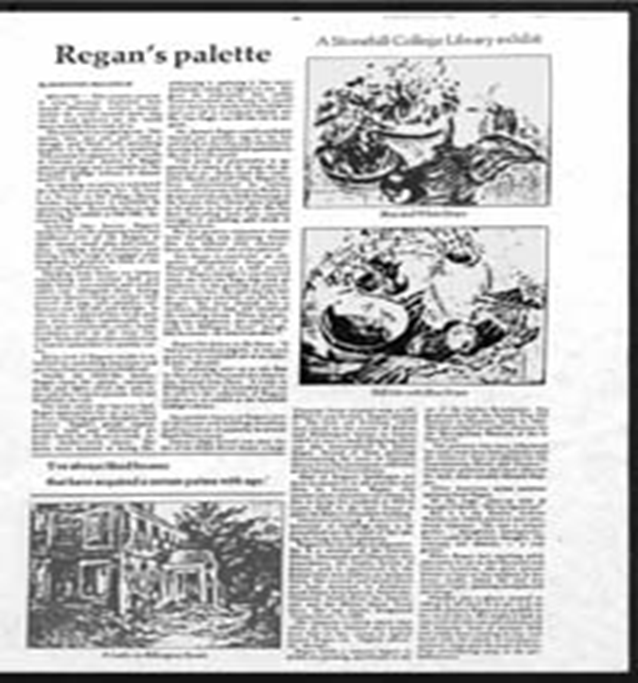
One old house in particular, an abandoned, tumbledown structure near Plymouth, was once a 19th-century mill owner’s house. In its elegantly ramshackle condition, Regan and her huge dog comfortably settled on a patch in the overgrown garden to paint it. She says she felt drawn to it. “It had a tremendous dignity, and it was gracious. It reminded me of an elderly lady.” Regan continued, “The entire time I was painting, I felt I was being watched, but in no danger.” Regan later learned that a reclusive dowager still inhabited the seemingly deserted house. When the painting was completed, she titled it “A Lady on Billington Street” after its cloistered occupant. The painting went on to win Best In Show at the Norwood Art Association Annual June Show. “A Lady on Billington Street” is included and can be viewed in the collection of her works on exhibit at Stonehill College this month.
Another feature of Regan’s love of old houses and buildings is a sense of posterity throughout several Boston towns and suburbs. Canton High School was once the site of the Elijah Morse Estate, a vast Victorian situated atop a hill. Before it was razed, Regan painted it, immortalizing it. She also commemorated the Little Red Firehouse on canvas, which once stood at the corner of Bolivar and Washington Streets in Canton (now, unfortunately, a strip mall). Several of her paintings documenting the town of Canton and its history are in the Canton Library's permanent collection.
Most of Regan’s landscapes are rendered in pastels or oils, and she works on location and in plein air. She teaches adult art classes and will be joining her students next month at Milton Lower Mills to paint the disused Baker’s Chocolate Factory and Mill, which is now undergoing re-gentrification. Immortalizing grand, humble, historical, or soon-to-be-demolished buildings is the result of Regan taking the long view for posterity.
Regan’s list of credits is impressive. She is a member of the Canton, Milton, Norwood, and Gloucester Art Associations, the Copley Society of Boston, and is represented by the Boston Fine Arts Gallery on Boylston Street. Her awards and juried shows are from museums and galleries throughout metro Boston and nationwide, and she was chosen as Designated Copley Artist in 1990.
Her response to being asked what effect all these ribbons and awards have had on her comes in typical Joanne Regan calm: “Slightly affirming,” she grins.
She holds a master’s degree in studio art painting, specifically in the art of the Italian Renaissance. She graduated from the former Pius XII Institute in Florence, Italy, and has worked in public relations for the Metropolitan Museum of Art in New York.
The painter who has influenced her most is Chardin, and she professes “an affinity for the impressionists, Monet and Cezanne.” Americans have also affected her style, most notably Edward Hopper. Other American artists summon opinions from Regan. Of the oversized, zoom-in style of Georgia O’Keeffe: “She intrigues me,” she said. But it’s the work of realist, Andrew Wyeth, that exacts a true emotional response from her: “He was a unique genius, thoughtful, introspective, not a realist (in artistic thought). His concepts are abstract—a true genius.”
When she isn’t teaching art in and around Boston, she gives private lessons to four or five students in her sunny studio, where they enjoy “painting, antiques, and other old things.”
Whether a mere glance around her studio or taking in all there is to survey, it’s no wonder Joanne Regan is as prolific as she is. It makes one wonder if her studio is “the muse.” She makes it look so easy with all that sun and whimsy and the innocent faces of antique dolls and teddy bears smiling back at you; laced with the fragrance of eucalyptus and painter’s turps, one can still distinguish the woodsy scent of cedar chips smoldering inside the pot-bellied stove in her charmed studio of color and art and daydreams.