
Wedding Fashions for the Ages – An Historical Account
By Dorothy V. Malcolm, Correspondent
There’s something about a wedding gown. Say those two words, and most women fairly swoon. Well, perhaps Victorian women “swooned,” today they’re more likely to discuss being a savvy consumer of wedding attire. But scratch the surface of any red-blooded gal and observe how the eyes widen, the pupils dilate, and the near-breathlessness occurs out of sheer, unabashed delight.
But let’s face it, there are wedding gowns, and there are wedding-gown-frowns. Some frocks resemble grandiose, tiered wedding cakes, while others seem to embrace a minimalist, Zen approach. What really matters is that from the first blush of interest between a man a woman, to the spoken vows of commitment, women the world over love costuming themselves to dazzle their grooms and inveigle their own castles in the sky. Women have always ornamented themselves for this profoundly important day, this universal rite of passage.
Since the mid-nineteenth century, white has been the brides’ color, based on the trend-setting influence of Queen Victoria. Why white? We’re told it represents purity, and in earlier times, joy. History also tells us it hasn’t always been the nuptial color of choice. In some cultures, white is the color of mourning, and red, in India and China, is the more favorable pigment to suggest the dignity and merriment of the occasion. Just imagine a crimson-clad bride floating down the aisle of an old New England clapboard church or dancing the wedding day away at one of Boston’s more conformist establishments. One might wonder if there was something wrong with this picture; on the other hand, others may wonder: Why not?
Strong colors have prevailed on wedding days far more often than white. In ancient Rome, maidens wore long yellow veils over their heads while brides in Eastern Europe spoke their vows in black, suggesting dignity and a seriousness of purpose. In Norway, green exuded and reflected spring’s promise, abundance, warmer weather, and longer days when all things blossom and grow.
According to a local expert, Jennifer Potts of the Braintree Historical Society and curator of its current vintage wedding gown exhibit, “Despite the bright array of rich fabrics and colors available to Medieval and Renaissance brides, white wedding dresses did make sporadic appearances during these periods. The color white was commonly associated with honor and spiritual purity...there existed a rich literary and musical tradition which celebrated romance and chivalry in the form of the beautiful, white-robed maiden and her heroic suitor.”
Thus, the power of white. But before the Victorian era, a riot of color was de rigueur for the European and early American bride. In Europe, designers used the artistry and ornamentation of beadwork, lace, and embroidery to beautify the dresses of French, Italian, Spanish, and English brides. By the time these glorified styles reached New England shores, through a lack of time, detail, and consistency, the patterns, fabrics, and embellishments were virtually impossible to duplicate here. In the late 18th and early 19th centuries, dolls were dressed in exact replicas of the latest European dress designs. These “fashion babies” were exact in every detail of normal-sized women’s dresses, only scaled down to doll size. Our colonial and early-American ancestors were then able to create a reasonable facsimile of what was worn in Europe. Unfortunately, these fashion babies arrived too late in the Boston, New York, and Charleston seaports. Thus, the supposed up-to-the-minute, 1840’s bride in America appeared more as a sorry has-been to her European counterparts of “high style and fashion.” It appeared that “obsolete” was an understatement to describe the “colonials” on this side of the pond.
But did it stop them? Of course not! If we Americans are nothing else, we are resourceful and innovative, and our ancestors were even more so. It was not unusual for the bride and her mother to sew interesting and pretty trims, tucks, and pleats into their wedding gowns. In fact, according to Jennifer Potts at the Braintree Historical Society, “The cuts of wedding dresses of the 1820s and 30s…long, full skirts (worn with several petticoats) and tight bodices which fastened at the front.”
Potts goes on to say that the most striking feature of wedding and ordinary dresses of the time was the variety of sleeves. “Sleeves could be round, puffy, tapered at the wrist or elbow, tied at intervals to form puffs, or flared from the upper arm.” She also explained that a particularly popular look drew the eye to the waistline that tapered to a “V-shape.” By the time American women caught on to the trendy V-shape and tailored their clothes for it, the look had gone out of fashion in Europe.
American wedding gown designs continued to flourish, despite the (belated) trends from Europe. Eighteenth and 19th-century women took a resourceful, sturdy, and practical approach to beauty, style, and the embellishments of their special clothing. Hearty New England girls, determined to make their wedding day special, pulled out all the stops to beautify and embellish their bridal frocks.
By the end of the 1800s and into the new century, wedding dresses became lighter, more delicate, floaty, and feminine. The V-shape at the waist was still popular and, according to Potts, “High, stiff collars and fashion for fussy, elaborate trimmings at the neckline, sleeves and hem, like chiffon ruffles and lace medallion trim were features of the 1880’s dress design.” As the century came to a close, American women relied on overlays of the more delicate fabrics “such as lace and surface embellishments for effect…tight, elbow-length sleeves and…at the shoulders epaulettes of lace.” Sometimes a brightly colored sash was worn around the waist to draw attention to the current mode, the to-die-for exemplar of beauty — the minus-20-inch waist.
Around the time of World War I, a popular look emerged: “moyen age,” which was a jewel-encrusted and embroidered bodice. “It was a romantic recreation of aristocratic weddings of the Middle Ages,” involving tassels, squared necklines, and embroidery interwoven with seed pearls or crystals, as described by Braintree Historical Society Curator Jennifer Potts.
When the Roaring '20s came thundering in, women got the vote, and their hemlines got shorter. Styles in wedding attire changed to a remarkable degree. While cotton cambric and lawn still offered the delicate, airy styles in wedding dresses, a creeping sense of independence and a more “free-thinking” perspective found its way in everything from the ubiquitous speakeasy right down to the bride’s dress. A dignified look was still “in,” but 20’s brides found themselves “trying to reconcile elements of innovative new styling, such as…different necklines…and shorter skirts with the more traditional wedding dress styles,” said Potts. The gowns of the 1920s were an eclectic development of ingenuity.
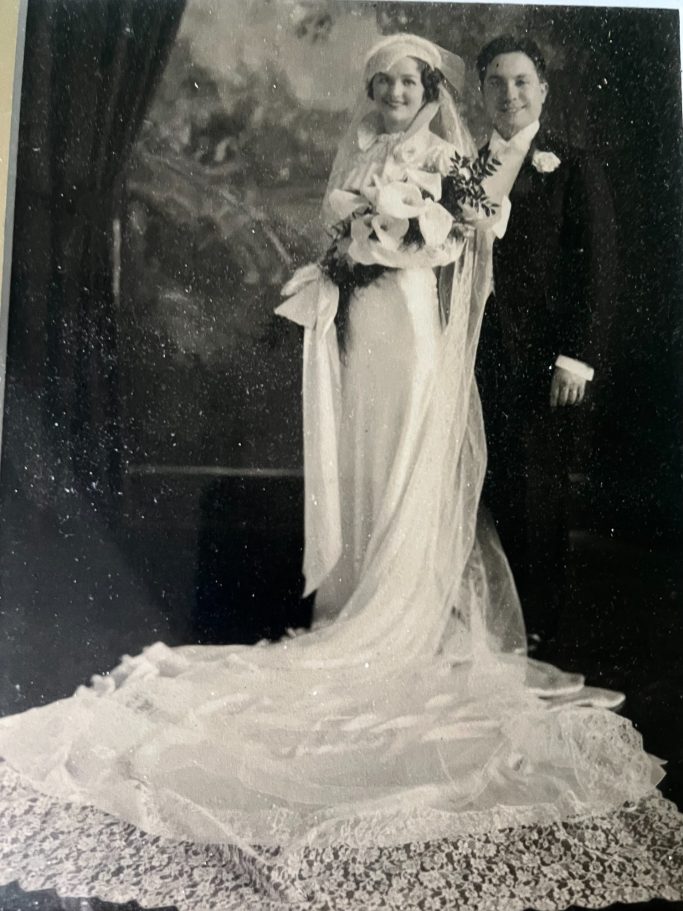
When the Great Depression hit America, with its soup kitchens, bread lines, and off-the-charts unemployment, bridal fashions reflected the simplicity and austerity of the time. But what is remarkable is that a new sense of glamour rose like a phoenix from the ashes of Depression-era deprivation. Fred Astaire and Ginger Rogers, the Ziegfeld Follies, and the Radio City Music Hall Rockettes, combined with the magic of motion pictures, satiated Americans with a sense of fun, wonder, apparent opulence, and hope despite the bleakness and setbacks that existed outside the theatres in the harsh light of day. This illusion of glamour translated to bridal attire. Satin was stunning yet affordable, and designers had to tweak every innovative design concept in their reserves of inspiration and originality. Rather than heavy embroidery, bejeweled bodices, and yards of lace, interesting seams set in unusual places/angles on a garment created its own architecture; appealing tucks and pleats; and rows and rows of self-covered buttons came to underscore the epitome of elegance.
The bridal train came into its own during the 1930s and 40s. The “train” has always been around to add drama to a gown, but the sweep, and again the ever-important cut of the fabric, is deliberate in gowns of this era.
Not all bridal trains are as dramatic as Princess Diana’s 25-foot swath of silk; some are mere elongations of the existing dress. But the evolution of the train is interesting because trains existed in Europe before the Middle Ages. A “cotehardie,” or a type of coat that brides wore, was richly embroidered and ornamental. (It translates to “bold coat” and has been around since the 14th century.) Over time, embellishment and a “sense of theatre” turned this cotehardie into a fashion statement that speaks volumes and is understood in all languages; in a word — “regal.” Nothing is more glamorous and ceremonial than a train. Call it fantasy, vanity, self-aggrandizement, or conceit, but nothing makes a bride feel more majestic than this fluid, sinuous raiment of the bridal train.
In fact, trains carried significant meaning; they lasted well into the war years. Glen Miller was making music that continues to resonate today. Vera Lynn and Jo Stafford sang, “We’ll meet again,” as soldiers marched off to war. Wartime and post-war American bridal gowns were, according to the historical society’s Potts, “Emphatically feminine…full skirts, long trains, and long, lacy gowns recaptured the romantic ideal.”
Wedding dresses of the 1950s and again in the 1980s were more reminiscent of the Civil War and antebellum gowns of Scarlet O’Hara. Full, sweeping frocks, volumized by hoops and petticoats, lavished with lace and dramatic sleeves, were in. Recall the voluminous sleeves and romantic, beribboned neckline of Princess Diana’s 1981 wedding gown, designed by London’s David and Elizabeth Emanuel.
By stark contrast, the gowns of the late 1960s and 70s were scaled-down, a study in a more tailored look. Anti-war sentiment was rife, make-love-not-war was the philosophy of the times, and young people were admonished not to trust anyone over 30. Anything that smacked (or whispered) of things traditional in attire was virtually scorned. Wedding gowns of the 60s were simple, even reminiscent of the 1930’s Art Deco styles, but minus the obvious glamour. They often sported high empire waists, semi-tailored cuts, and A-line silhouettes. Some gowns could be stately and elegant, but few could be called ultra-romantic or traditionally conformist. Glamour, if it ever existed in 60s gowns, was either subtle or bashfully inferred.
Even the 1990s enjoyed a minimalist renaissance, as evidenced by the stark simplicity of the gowns, such as the one worn by the late Carolyn Bessette on her wedding day to John F. Kennedy, Jr. And Hollywood designer Vera Wang has been instrumental in influencing that pared-down “slip dress” in lavish fabrics and cut on the bias. The look lends itself to the garment's seductive drape and cadence while echoing some Art Deco inspirations.
Traditional marriages, levels of cohabitation, and the mating game may come and go with the eras and as cultures evolve, but the lure of the wedding day — that eternal, universal rite of passage is here to stay. Romance is always in the air, and for some blushing brides, pure oxygen. Pick up any bridal magazine and scan the myriad styles of gowns and accouterments available. Upon closer inspection, it’s easy to see how there really is nothing new under the sun: it makes it quite clear how history, fashion, or otherwise, keeps repeating itself.
Article first appeared in “Fall Weddings,” September 2001, CNC/Herald Media Publishing, Boston.
Article was subsequently picked up and refashioned for“The Forum,” Mariner-Community News, Boston
Dorothy V. Malcolm is a freelance writer and author specializing in art and historical subjects. She resides in Salem and Ipswich and can be reached at DVMBoston@gmail.com